
Overview
QuizDuel, or Quizkampen in Sweden, had been part of the daily phone habits of a huge audience for years. QuizDuel 2 was its intended successor: the same duel at the core, rebuilt on a modern client with room for the progression and social systems the original had never had. In 2017, I joined as the team’s only designer when there was a rough but working technical demo, and owned the project’s look and feel from that point on.
- Art direction: I set the visual identity for the sequel, covering colour, form language, typography, lighting and iconography, keeping QuizDuel unmistakably itself while modernising without alienating a player base that had used the same app for years.
- UX and UI: I designed the full interface, from the game list and duel flow to leagues, statistics, quests and the shop, and produced production graphics.
- Game design: I helped shape the gameplay loop and the systems around it, adding new question formats beyond plain multiple choice so rounds kept their variation, and tying retention to avatar unlocks earned through play so a returning player always had something to collect.
- Animation and VFX: I mocked up the more complex sequences in After Effects and finished them in Unity, tuning timing and adding particle work directly in engine.
The game
The original QuizDuel was a phenomenon in its home market: a turn-based trivia duel that people played with colleagues, family and strangers throughout the day. That success was also the constraint. The app had been iterated on for years rather than redesigned, and its interface had started to show its age next to newer competitors. Its players knew every screen by heart and a large share of them had never played anything else on their phone.
The challenge
The sequel had a lot to live up to. Everything needed to look sharper, feel better and offer more to do, while the main gameplay loop itself stayed exactly what players expected from it. The goal I worked towards throughout the project was a game that felt new and fresh, yet instantly recognisable to someone who had played the original.
My role
I joined a five-person core team that had a rough but working technical demo but no design or visual identity whatsoever. I covered art direction, UX, UI, production graphics and illustration, animation and visual effects. The one part I did not do myself was the avatar artwork, which our in-house artist took the lead on.
Tools & approach
Interface work was done primarily in Photoshop, with Sketch supporting layout and screen flows. Illustrations and production graphics were created in Photoshop and Illustrator and delivered as production-ready assets. Complex animations were mocked up in After Effects before anything was implemented. Developers rebuilt them in Unity, after which I went into the engine myself to tune timing and easing, and to add particle effects and the smaller flourishes that are easier to feel than to specify.
More and better!
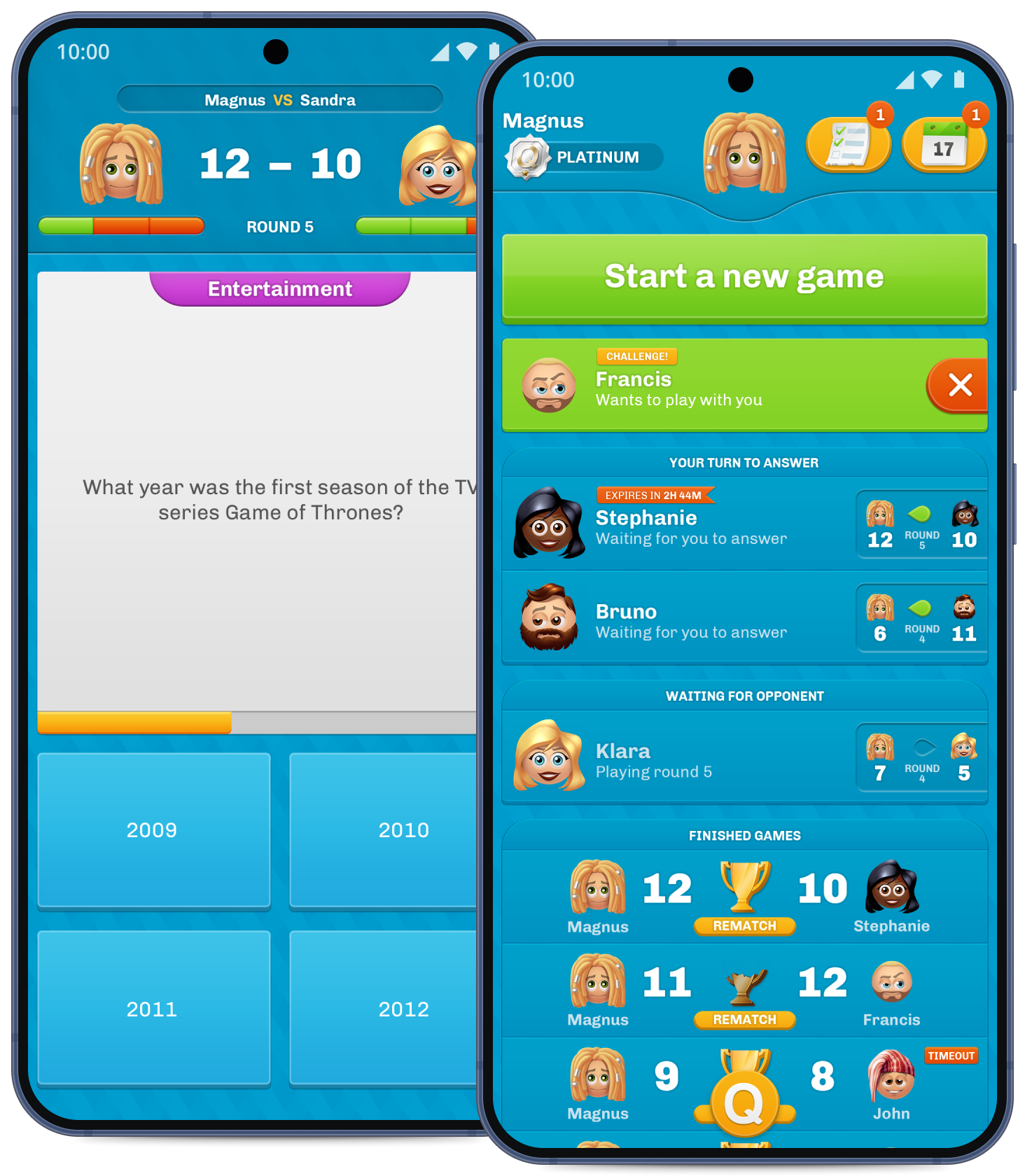
The core of the project: a rebuilt experience wrapped in a new visual identity, with the progression and social systems the original never had room for.
I rebuilt the interface around what the players already knew, then added a refreshed identity on top of it: a deeper, more saturated palette, soft dimensional buttons and clearer typographic hierarchy.
With the new flow and layout, the sequel could carry new systems. Leagues gave the ladder more meaning than a single ranking number, expanded player statistics let people see their own category strengths, and daily challenges and quests gave a reason to open the app every day whether or not they had a game turn to play. Each of these was designed to sit inside the existing loop rather than beside it.
Never the same question twice
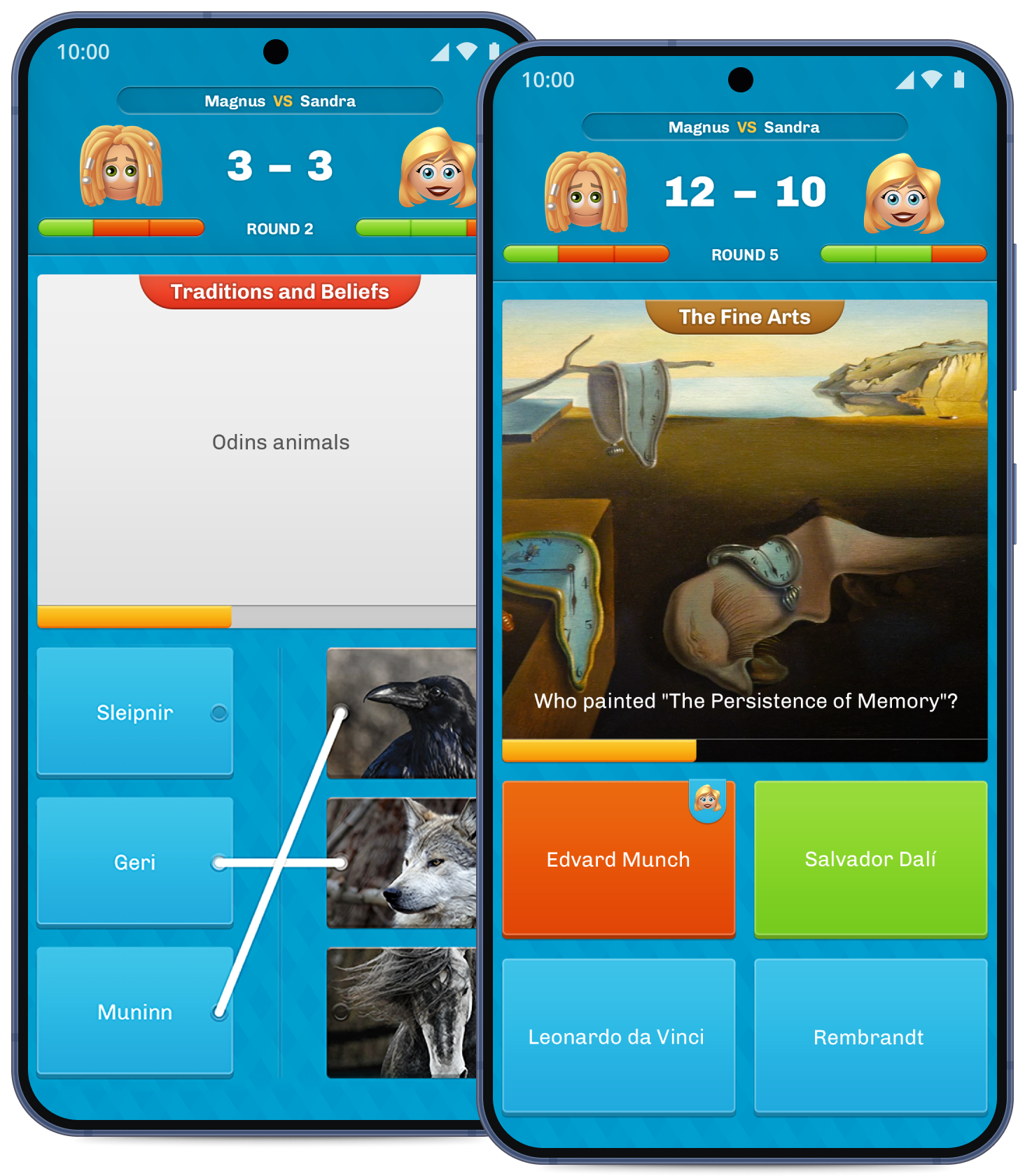
The tightest constraint of the redesign was inherited from the original: a trivia database of tens of thousands of multiple choice questions, every one of them written to be read and answered in a few seconds. Any new format had to work together with that library exactly as is. Within that limit I designed and implemented several new question types that worked alongside the original ones but that gave players different ways to show what they knew. I also worked over the duel interface itself with graphics and visual effects throughout, so a quiz round felt considerably more alive without taking any longer to play.
Express yourself
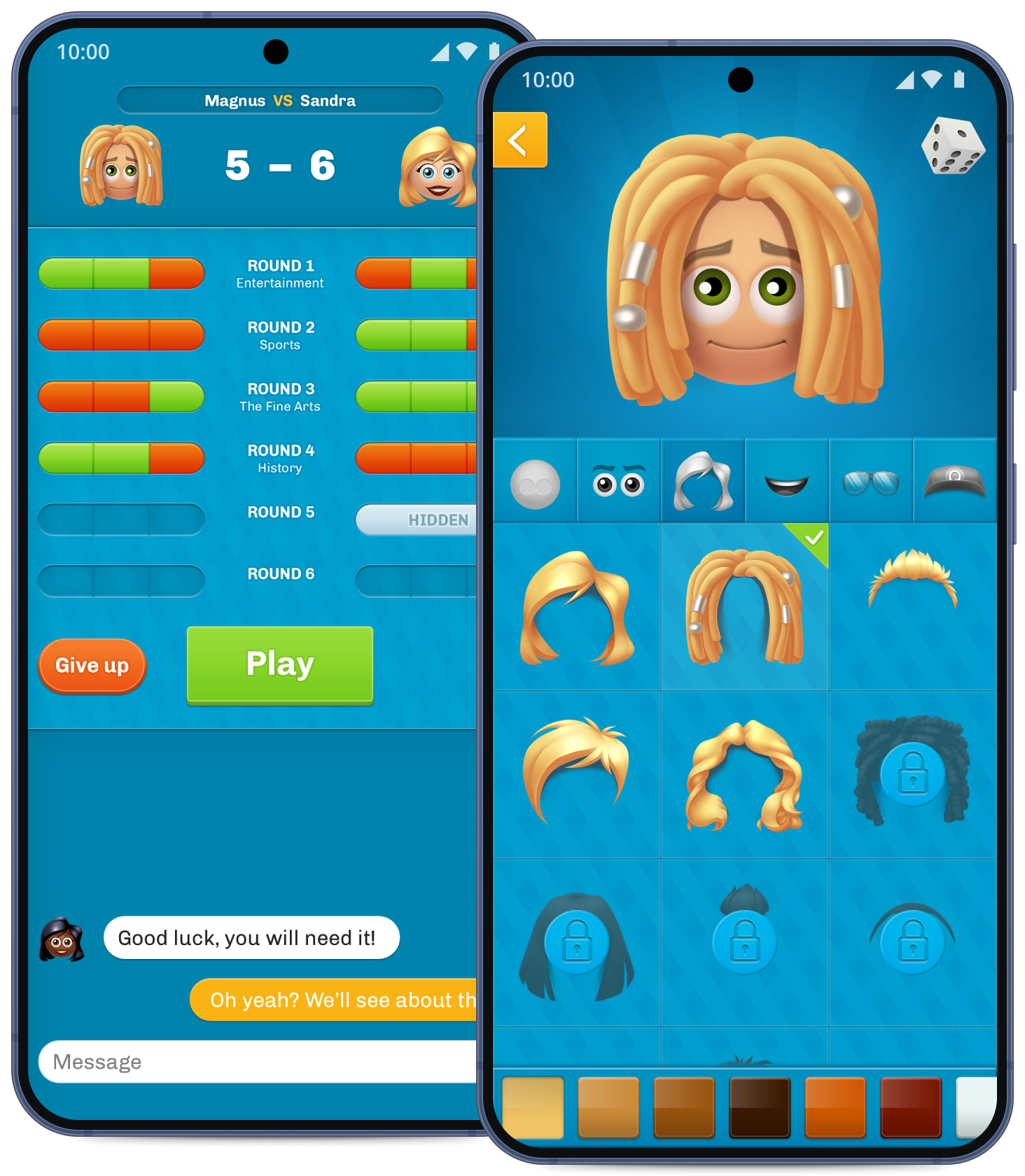
I planned and designed a customisation system built from hundreds of combinable parts, including hair, eyes, mouths, skin tones, headwear and accessories. The avatar art was created by our in-house artist. I modified the supplied assets and created filters that could be applied programmatically to allow for further customization of individual art assets.
Rather than being a separate window as in the original QuizDuel, the chat was rebuilt to be available throughout the app so the conversation could be kept going everywhere, even during play.
Rewarding players
A mobile game only retains players as long as there is something waiting for them when they come back. The original only rewarded a returning player with the same thing: another duel. There was no moment of payoff, and nothing was accumulated over weeks of play. If you liked the game, you could go premium and get access to all avatar options, but there was no real sense of progression.
In QuizDuel 2, we introduced gift boxes, earned by winning quiz duels and completing quests and daily challenges. When opened by the player, they unlocked new parts to use for their avatar. Tying rewards to the customisation library meant progression was something you both could see on your own face, as well as show off to your opponent in every duel.
How far it got
QuizDuel 2 reached late closed beta with hundreds of external testers. Initial feedback was great: everyone recognised the game immediately, and the additions, such as leagues, quests, the new question formats and the new avatar builder, were received as things the original had been missing rather than as novelties bolted on. By that stage it felt close to something we could put in front of a wider audience.
During that beta, our studio and its portfolio of games were acquired by another company. The original QuizDuel had a large and habitual player base, and the new owners chose not to risk migrating it to a sequel while the merger was under way. The original stayed live and QuizDuel 2 was shelved. I understood the reasoning, though it was a shame not to get to launch and find out how it would have performed.
Reflection
When working on a game, it’s clear that an interface has another job apart from being functional and frictionless; it also has to be entertaining and feel good to use in its own right. That is not a lesson confined to games, since any product is better when an interface feels rewarding to use, and it is something I have taken with me into work that has nothing to do with play. Much of that lives in the timing. A few hundred milliseconds of easing on a button, a short pause before a gift opens, or a bounce that settles at just the right moment. None of it shows up in a static mockup but it is what decides whether a screen feels alive or inert and is why I did the final pass inside the engine.
The other lesson was restraint. A good part of the work was identifying what could not be touched, in this case the gameplay loop and the existing library of questions, and figure our how to work around it.
QuizDuel 2 might never have shipped, but it changed how I have approached every product I have worked on since.